Updates

New updates and improvements to Userorbit.

New

Theme support for product tours

You can now build product tour themes with dedicated light and dark variants.

Theme support makes tours feel native in applications that support dark mode, follow system preference, or need different styling for different surfaces.

What is included:

  • Switch between Light and Dark while editing a theme.

  • Preview product tours, tooltips, banners, checklists, and surveys before saving.

  • Customize colors, text, overlays, buttons, borders, arrows, beacons, and badges per mode.

  • Use light, dark, or system from the SDK to match your application theme.

  • Update the active theme mode at runtime with userorbit.updateTheme().

This is available now from Tours → Themes.

Built from 1 request · 2 votes
New

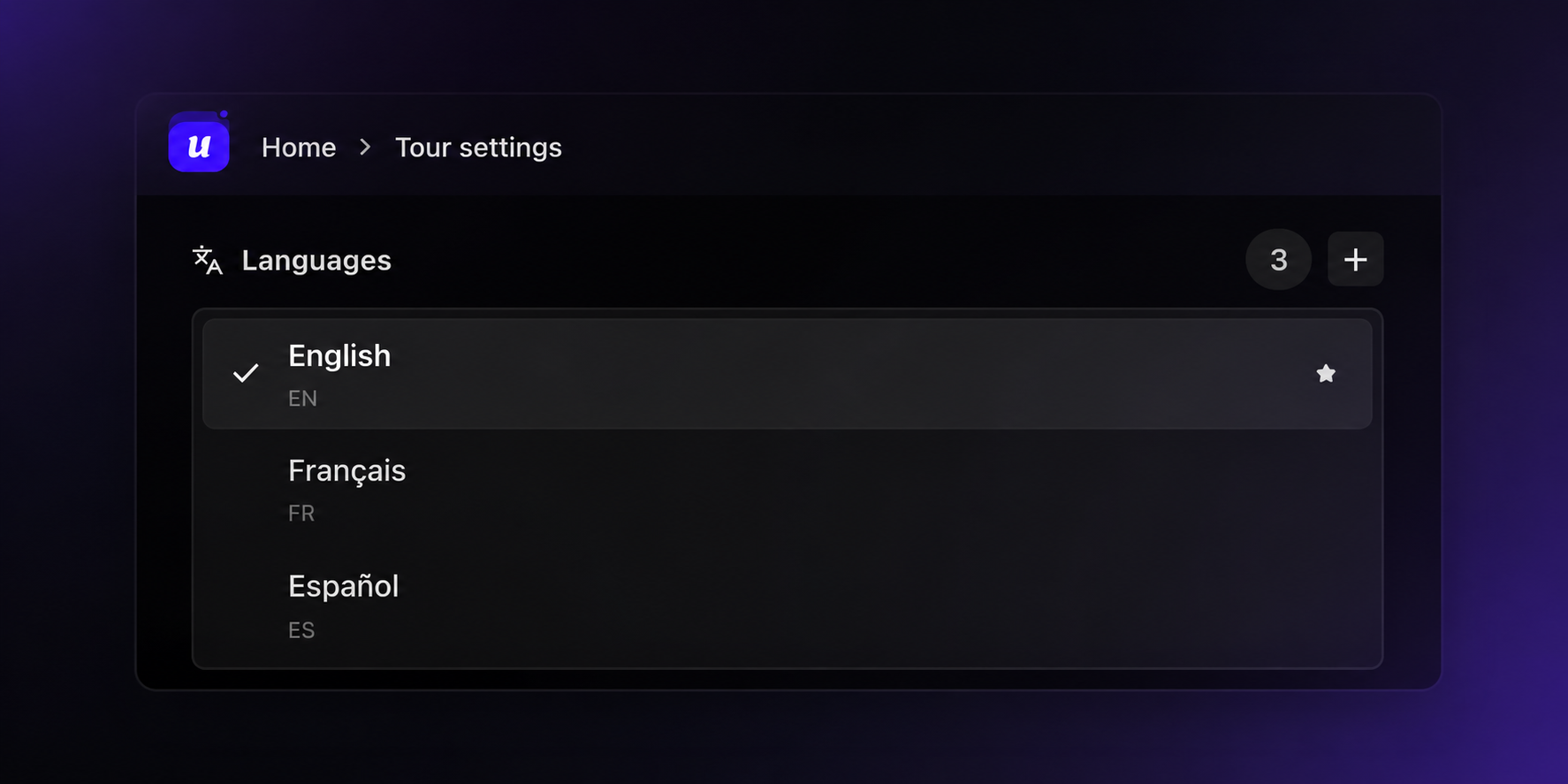
Multi-language support for product tours

You can now create product tours in multiple languages, making it easier to onboard and guide users across global audiences.

Add languages from Tour settings, choose a default language, and translate each tour step without duplicating the entire tour. Userorbit will serve the right content based on the selected or detected locale, while falling back to your default language when a translation is not available.

This is especially useful for teams shipping onboarding, feature education, and in-app announcements to customers across regions.

What is included:

  • Add and manage supported languages for each tour.

  • Set a default language for the canonical tour content.

  • Translate step titles, descriptions, progress text, and button labels.

  • Preview translated tours while editing.

  • Use locale-aware delivery from the JavaScript SDK.

Multi-language support is available now for product tours.

Integration

Userorbit MCP Server is now available

Managing Userorbit resources like announcements, feedback, roadmaps, and help content often requires switching between multiple tools and platforms, disrupting your development and communication workflows.

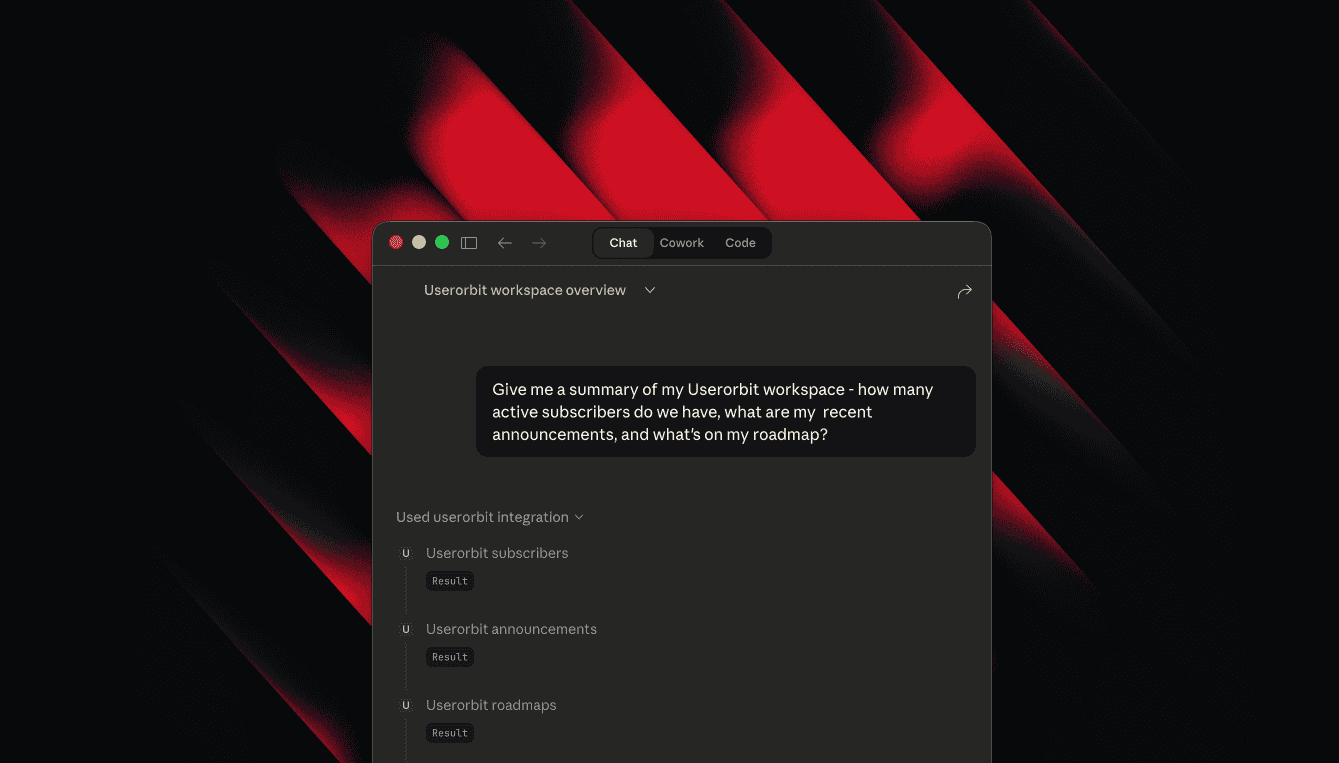
So we're excited to announce the release of the Userorbit MCP Server. This new server allows you to manage all your Userorbit resources directly from popular MCP-compatible AI assistants such as Claude Code, Claude Desktop, Cursor, Windsurf, and VS Code, streamlining your product communication and development processes.

A few things you can do with this:

  • Create and update announcements from release notes without leaving your editor.

  • Triage feedback, move items across roadmaps, and keep product plans current.

  • Draft and maintain help center articles alongside product changes.

  • Manage subscribers, tags, and projects through the same assistant workflow.

Getting Started

  • Add @userorbit/mcp to your MCP configuration using the command npx.

  • Set your USERORBIT_API_KEY and USERORBIT_TEAM_ID, which can be found in Settings → API.

  • Start your AI assistant and begin calling resource tools with an action and relevant params.

The Userorbit MCP Server is available now. It currently exposes 17 resource-level tools across the Userorbit API, with more integrations planned for the future.

New

Introducing Codebase Intelligence

What if your code could update your docs, tours, and changelogs?

Connect your GitHub repo and we start watching for changes. We scan your codebase to map every feature, route, and endpoint, detect what changed, and propose updates across every channel — help docs, tours, changelogs, surveys, and announcements.

Nothing auto-publishes. You review and approve.

Code changes. Content follows.

Updates

AI usage quotas and plan-based access

AI-powered features — changelog generation, writing assistant, and autopilot — are now metered by plan. Each plan tier includes a monthly quota of AI generations.

You can track your current usage and remaining quota from Workspace Settings → Usage. When you approach your limit, you will see a notification in the editor. Quotas reset on the first of each month.

Free plans include a limited number of generations to try the features. Pro and Enterprise plans include higher quotas suitable for regular use. If you need more, contact us about custom limits.

AI

Automate your announcements and help articles

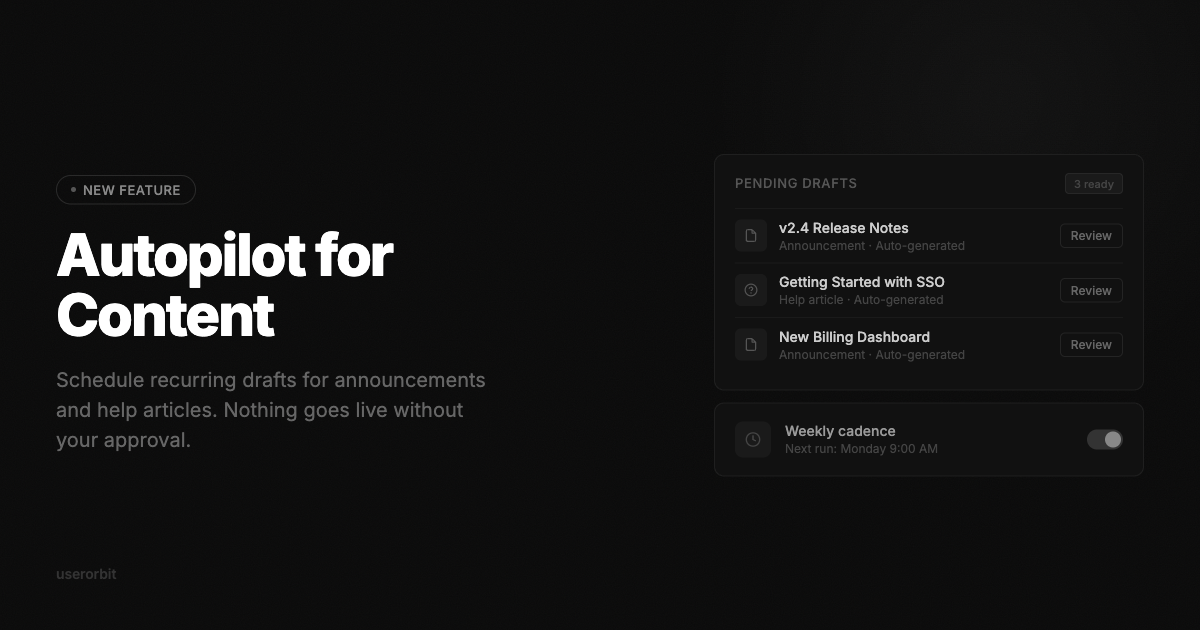
The automation engine lets you schedule recurring content generation. Set a cadence — weekly, biweekly, or on every release — and Userorbit drafts announcements or help articles from your connected sources automatically.

Each automation run produces a draft you can review, edit, and publish. Nothing goes live without your approval.

Access automations from the Cmd+K agent panel or the dedicated Autopilot page. The stats view shows generation history, publish rates, and average time from draft to publish.

Autopilot is available on Pro and Enterprise plans.

AI

Generate changelogs from GitHub commits and Slack threads

Connected a GitHub repo or Slack workspace? You can now select a range of commits or a thread and have Userorbit draft a changelog entry from the source material.

The generation pipeline streams results with live thinking steps so you can follow the reasoning as it writes. Once a draft is ready, you get action chips to publish, save as draft, or archive — one click to move it forward.

Every AI-generated action supports undo. If you publish and change your mind, roll it back without hunting through version history.

This works for announcements today. Help center article generation is coming next.

Improved

Help center organization, team invites, and AI writing assistant

The help center now has an Organize page with a drag-and-drop tree view. Reorder articles within collections, move articles between collections, and nest subcategories — all without leaving the page.

Team invitations have been streamlined. Invite members by email, assign roles upfront, and track pending invitations from the team settings page. Accepted invites now provision access instantly.

The announcement editor includes an AI writing assistant. Open the chat panel, describe what you want to say, and get a draft you can edit inline. The assistant uses your workspace context — recent changes, product name, tone — to produce relevant first drafts.

New

See how your tours, surveys, and announcements perform

Every tour, survey, and announcement now has its own analytics view. See completion rates, step-level drop-offs, and engagement trends over time.

For tours, track which steps users finish and where they abandon. For surveys, see response distributions and completion percentages. For announcements, monitor read rates and reaction breakdowns.

A workspace-level dashboard aggregates performance across all entities — total views, unique engagers, and weekly trends. Filter by date range or content type to focus on what matters.

Analytics are available on all plans with no additional setup.

Integration

Connect GitHub and Slack to your workspace

Userorbit now integrates with GitHub and Slack to bring your development activity and team conversations into one place.

GitHub: Connect via OAuth and select which repositories to track. Userorbit indexes commits, pull requests, and releases so you can reference real changes when writing announcements.

Slack: Link channels and threads to your workspace. Surface product discussions, customer requests, and internal decisions alongside your content pipeline.

Both integrations are managed from a centralized Integrations settings page. Connect once, then use the data across announcements, help articles, and roadmap items.

New

Personalized content, compact feedback, and faster creation

Announcements, tours, and checklists now support subscriber variables. Insert merge tags like {{name}} or {{plan}} and each subscriber sees content tailored to their profile.

The authoring UI makes it easy to browse available variables and insert them inline. Variables resolve at render time, so you write once and every subscriber gets a personalized experience.

Other updates in this release:

  • Quick-create for checklists and surveys — start from a template instead of a blank canvas
  • Compact feedback mode — a minimal feedback prompt that takes less screen space
  • Voice feedback — let users leave audio responses alongside text
  • Inset tooltips, live entity links in the editor, and external link support in tours
New

A completely redesigned widget

The embedded widget has been completely rebuilt. The layout is cleaner, transitions are smoother, and the entire component renders significantly faster.

Key changes:

  • Active tabs — filter between announcements, feedback, and roadmap items without leaving the widget
  • Updated card design with better visual hierarchy and spacing
  • Lazy-loaded content panels so the widget opens instantly
  • Improved dark mode support with consistent contrast ratios

The widget is still initialized the same way — no code changes required on your end.

New

Publish a help center on your own domain

You can now publish a help center directly from Userorbit, hosted on your own domain via userorbit.help subdomains or a custom CNAME.

Articles are organized into collections — group related content so customers can browse by topic instead of scrolling a flat list. Each collection gets its own landing page with article previews.

The help center includes full-text search, responsive layouts, and automatic SEO metadata. Write articles in the same editor you use for announcements, then publish them to a public knowledge base your customers can access without logging in.

If you currently maintain docs in a separate tool, this is a good reason to consolidate.

Improved

Carousel tours, portal redesign, and builder improvements

Tours now support carousel steps — multi-panel layouts that let you walk users through related features in a single step. Swipe or click through panels without advancing the entire tour.

The portal has a fresh visual design with cleaner spacing, updated typography, and improved loading performance.

A few more highlights:

  • overrideDismissed — re-show tours that users previously dismissed, useful for re-onboarding after major changes
  • Chrome extension layout improvements for narrower viewports
  • Builder v0.0.13 with better step reordering and preview accuracy
New

Now Supporting 45 Languages

For months, teams asked if Userorbit could support more than English. Requests came in for Spanish, French, Hindi, Chinese, and dozens more. The message was clear: adoption only works when you can guide users in their own language.

Today we’re excited to share that Userorbit now supports 45 languages across tours, checklists, and surveys. From English, Español, Français, Deutsch, 日本語 to हिन्दी, Русский, 한국어, 简体中文, and beyond—you can now deliver onboarding in the languages your customers actually use.

This makes targeting sharper, experiences smoother, and adoption easier worldwide. And we’re not done: RTL (right-to-left) support is in progress, with more languages on the way.

Why it matters

Until now, content lived in one language. That meant global teams had to compromise. With multi-language support, you can guide, survey, and engage users in their preferred language—without extra setup.

What’s next

Auto-detection by user settings, full RTL support, and deeper localization tools (dates, numbers, formats).

Start creating multi-language onboarding today inside Userorbit.

Explore Multi-Language Support →